Between 1863 and 1865 the roads of the South West Slopes belonged, in popular memory at least, to Ben Hall and his companions. The gang robbed coaches, stations, stores and travellers across a wide sweep of country, and their exploits — and the deaths that came with them — are marked by graves and memorials in nearly every town on this trail. The route also passes through Young, formerly Lambing Flat, where the riots of 1861 left a harder legacy.
Route: Yass – Binalong – Harden – Jugiong (optional) – Wallendbeen – Cootamundra (optional) – Young – Grenfell – Forbes.
≈230 km
Main route
Yass to Forbes
2¾ hrs
Driving time
Without stops
1863–65
Gang’s peak years
Hall, Gilbert, Dunn and others
The gang in brief
Ben Hall was a stockman and small landholder in the Weddin Mountains district who drifted into bushranging in the early 1860s and took part in Frank Gardiner’s Escort Rock robbery of 1862. After Gardiner left the district, Hall led a gang whose members at various times included John Gilbert, John O’Meally, John Vane, Michael Burke and later John Dunn. Their robberies grew bolder — whole towns were held up — and in 1864 and 1865 they killed two police officers. In April 1865 the NSW Parliament passed the Felons Apprehension Act, which allowed declared outlaws to be shot without warning. Hall was killed by police near Forbes on 5 May 1865; Gilbert was shot near Binalong eight days later; Dunn was captured and hanged in 1866. For the full story see our bushrangers guide.
Yass
Yass sat on the Great Southern Road and was an important police and coaching centre during the gold years; protecting gold escorts on the main southern road was a major part of the town’s life. Today its main street retains handsome Victorian buildings, and the town makes a convenient start for both this trail and the Southern Gold Trail.
Binalong
The little village of Binalong, with its old store, bank and hotel, is where John Gilbert met his end. On 13 May 1865, Gilbert and Dunn were sheltering at a house near the town when police, acting on information, surrounded it. In the exchange of fire Gilbert was killed. He is buried in a small fenced grave near the town, now a quiet stop just off the road. Binalong is also associated with the poet A. B. Paterson, who spent his early childhood in the district.
Harden and Murrumburrah
The twin towns of Harden and Murrumburrah were bushranger territory in the 1860s. Look for the local museum, Chinese graves in the cemetery that recall the district’s Chinese residents, and stories of the Hall and Gardiner gangs in the surrounding hills.
Detour: Jugiong
A short detour south brings you to Jugiong on the Murrumbidgee, a village that grew up around a coaching inn. On 16 November 1864 Gilbert, Hall and Dunn held up the mail coach near Jugiong. In the gunfight that followed, Sergeant Edmund Parry was shot dead — the killing for which Gilbert and Dunn were later held responsible. Memorials in the district commemorate Parry.
Wallendbeen and Cootamundra
Wallendbeen is a small farming village between Harden and Cootamundra. Nearby, in November 1863, gang member John O’Meally shot storekeeper John Barnes, who had resisted a robbery. Optional Cootamundra is a railway town best known as the birthplace of Sir Donald Bradman in 1908.
Young: Lambing Flat
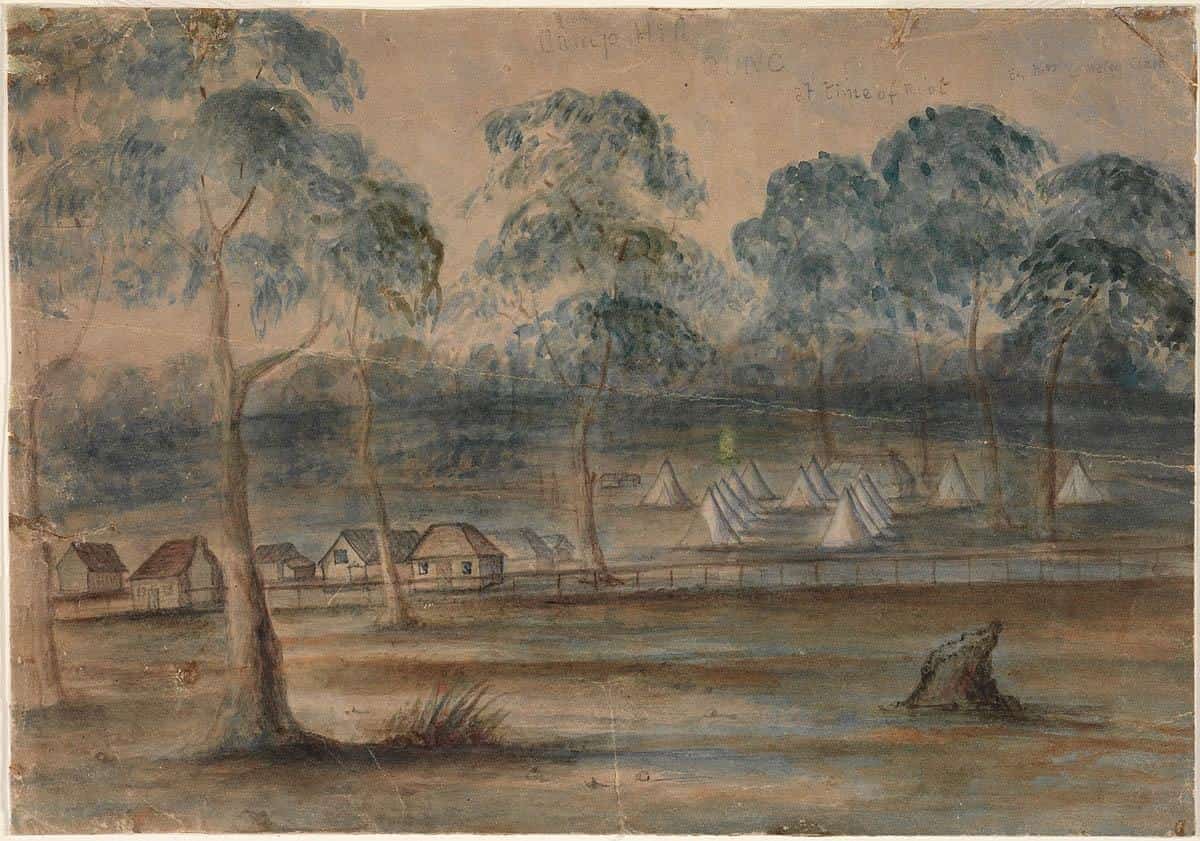
Gold was found at Burrangong — Lambing Flat — in 1860, and within months thousands of miners were on the field. Tension between European and Chinese miners erupted in a series of attacks, culminating on 30 June 1861 when 2,000 to 3,000 men drove the Chinese from the diggings. When three ringleaders were arrested in July, around 1,000 miners attacked the police lock-up and one miner was killed. Martial law followed. The town was later renamed Young after the governor, Sir John Young.
Today the Lambing Flat Folk Museum tells this story and displays the “Roll Up” banner associated with the riots. Young is also known for its cherries, and the Chinese Tribute Garden is a peaceful place to reflect on the Chinese contribution to the town. Read our in-depth guide to the Lambing Flat riots.
Grenfell
Gold was discovered at Grenfell in 1866, and the town grew quickly on alluvial and reef gold. The writer Henry Lawson was born on the Grenfell goldfield on 17 June 1867, and the town holds an annual festival in his name. On O’Brien’s Hill you can see abandoned workings and machinery. The Weddin Mountains, south-west of town, were Ben Hall’s home country; a national park there includes a cave long associated with the bushranger and the site of his homestead. Check NSW National Parks for access before you go.
Forbes
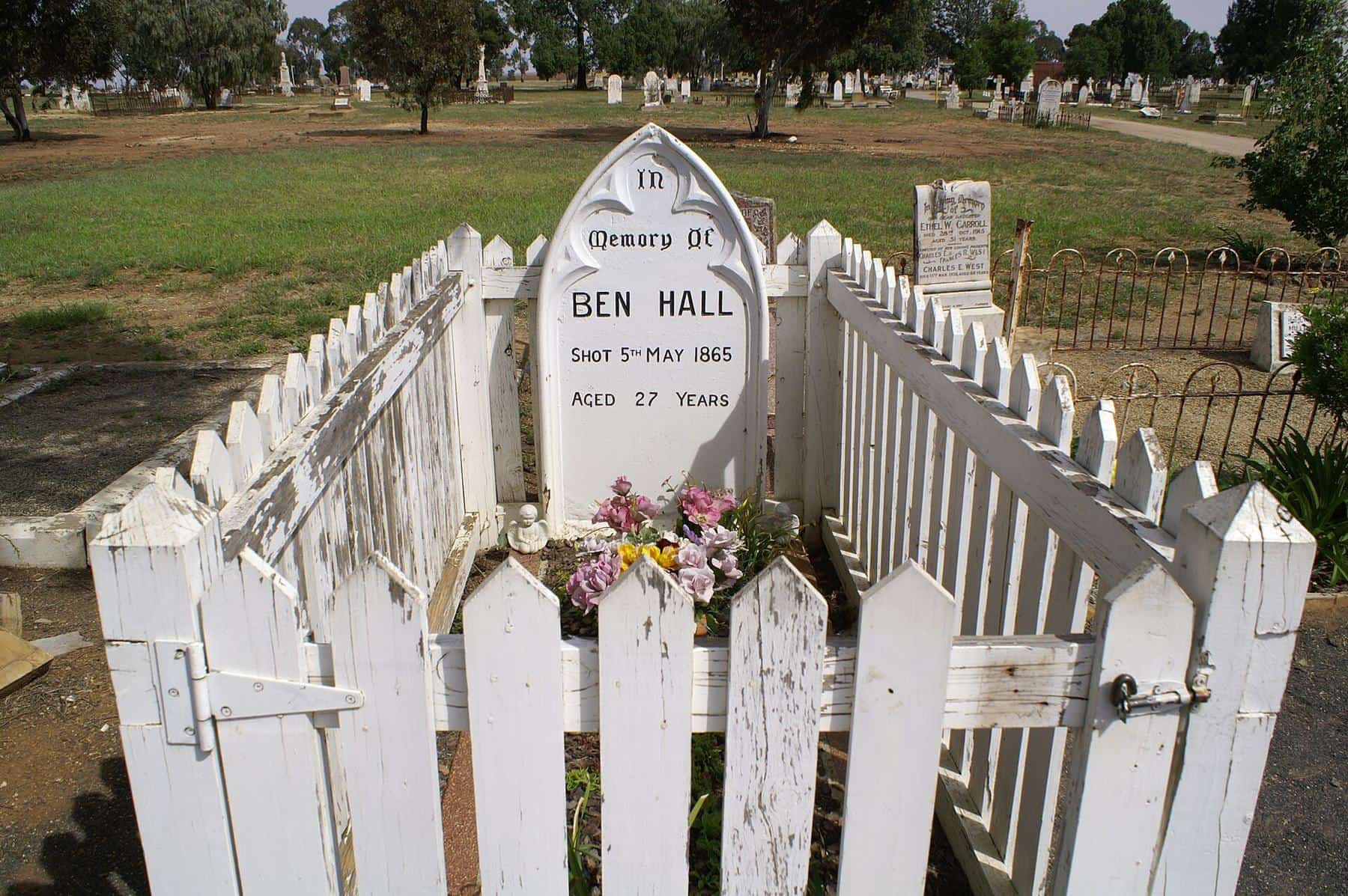
The trail ends in Forbes, the hub of the Lachlan goldfield and the place where Ben Hall’s story ended. He was shot dead by police at dawn on 5 May 1865 on Goobang Creek, north-west of the town. His grave in the Forbes cemetery is still visited, and often decorated, by people from across the country. The town’s museum has bushranging displays.
Ben Hall Gang trail checklist
0 of 8 done
Ticks are saved in this browser only.
A note on the legend
Ben Hall is remembered in ballads and films as a reluctant outlaw driven to crime by police harassment. Historians give a more mixed picture: the gang’s raids terrified communities, and the deaths of Sergeant Parry and Constable Samuel Nelson (shot by Dunn at Collector in January 1865) were real tragedies for their families. Visiting the graves of both bushrangers and police on the same trip is a good way to hold both sides of the story.
Where to next
From Forbes, continue on the Escort Rock Gold Trail in reverse to Bathurst, or head north on the Newell trail. From Yass, the Southern Gold Trail runs to Gundagai and Kiandra.
Frequently asked questions
Where is Ben Hall buried?
Ben Hall is buried in the Forbes cemetery. He was shot dead by police on Goobang Creek, north-west of Forbes, on 5 May 1865.
Where is bushranger John Gilbert buried?
John Gilbert is buried at Binalong, between Yass and Harden. He was shot by police near the town on 13 May 1865, eight days after Ben Hall’s death.
How long does the Ben Hall Gang Gold Trail take?
The main route from Yass to Forbes is about 230 km, or roughly two and three-quarter hours of driving. With museum stops and the optional Jugiong and Cootamundra detours, plan a full day or two relaxed days.
What was the Lambing Flat riot?
A series of violent attacks by European miners on Chinese miners at the Burrangong goldfield, near today’s Young, in 1860–61. The worst, on 30 June 1861, drove the Chinese from the field and led to martial law and an anti-Chinese immigration law.
Sources and further reading
Facts on this page were checked against these primary and official sources. Conditions change — confirm before you travel or buy.
- Hall, Benjamin (Ben) (1837–1865) — Australian Dictionary of Biography
- Gilbert, John (1842–1865) — Australian Dictionary of Biography
- Lambing Flat Folk Museum — Destination NSW
- Felons Apprehension Act 1865 — NSW Legislation