If you only drive one gold trail, make it this one. In roughly 200 kilometres the Escort Rock Gold Trail links the town where the Australian gold rush was announced, the creek where the first payable gold was found, the most complete gold-era village in New South Wales and the scene of the colony’s most famous gold robbery. It follows, in part, the line of the old road along which gold escorts carried the yield of the western diggings towards the banks.
Route: Bathurst – Sofala (optional) – Hill End (optional) – Lucknow – Orange – Ophir (optional) – Cudal – Canowindra – Eugowra – Forbes.
≈200 km
Main route
Bathurst to Forbes, excluding detours
2½ hrs
Driving time
Without stops or detours
2 days
Recommended
With Hill End and Sofala
Before you go
The trail can be driven in either direction, but starting in Bathurst follows the story chronologically: discovery first, robbery later. Bathurst and Orange have the widest range of accommodation; Forbes is a good overnight stop at the western end if you plan to continue on the Ben Hall Gang trail or the Newell trail.
The Hill End detour uses narrow, winding roads with steep sections; it is fine for cars but not ideal for towing. Mobile coverage is unreliable around Hill End and Sofala, so download maps beforehand. In winter, frost and fog are common in the early morning on the tablelands around Orange.
Bathurst: where the rush began
Bathurst was proclaimed by Governor Lachlan Macquarie in 1815, making it the oldest European settlement west of the Blue Mountains. By 1851 it was an established pastoral town — and it was here, on 15 May that year, that Edward Hargraves made public the gold discoveries he and his partners had made on the creeks to the north-west. The news spread to Sydney within days and the road over the mountains filled with would-be diggers.
Walk the civic precinct around Russell and William streets to see the grand courthouse and the commercial buildings that gold money paid for. Chifley Home, the modest house of Prime Minister Ben Chifley, is a reminder that Bathurst’s story continued well past the rush. If you have time, drive the Mount Panorama circuit, which is a public road with a 60 km/h limit outside race events.
Detour: Sofala and the Turon
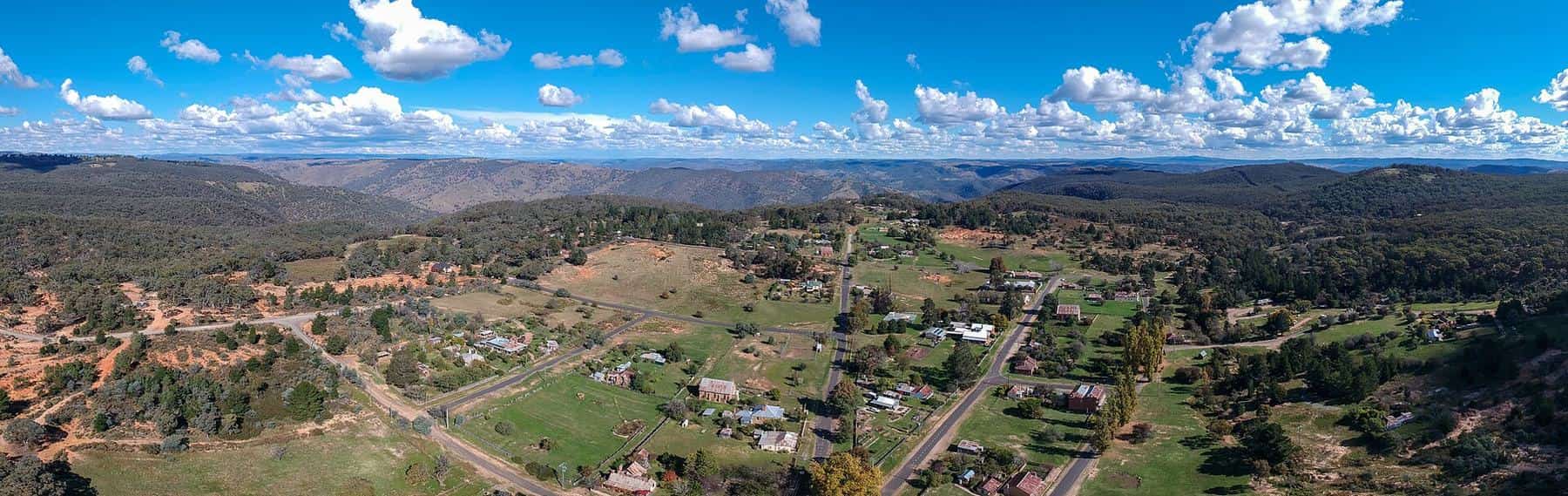
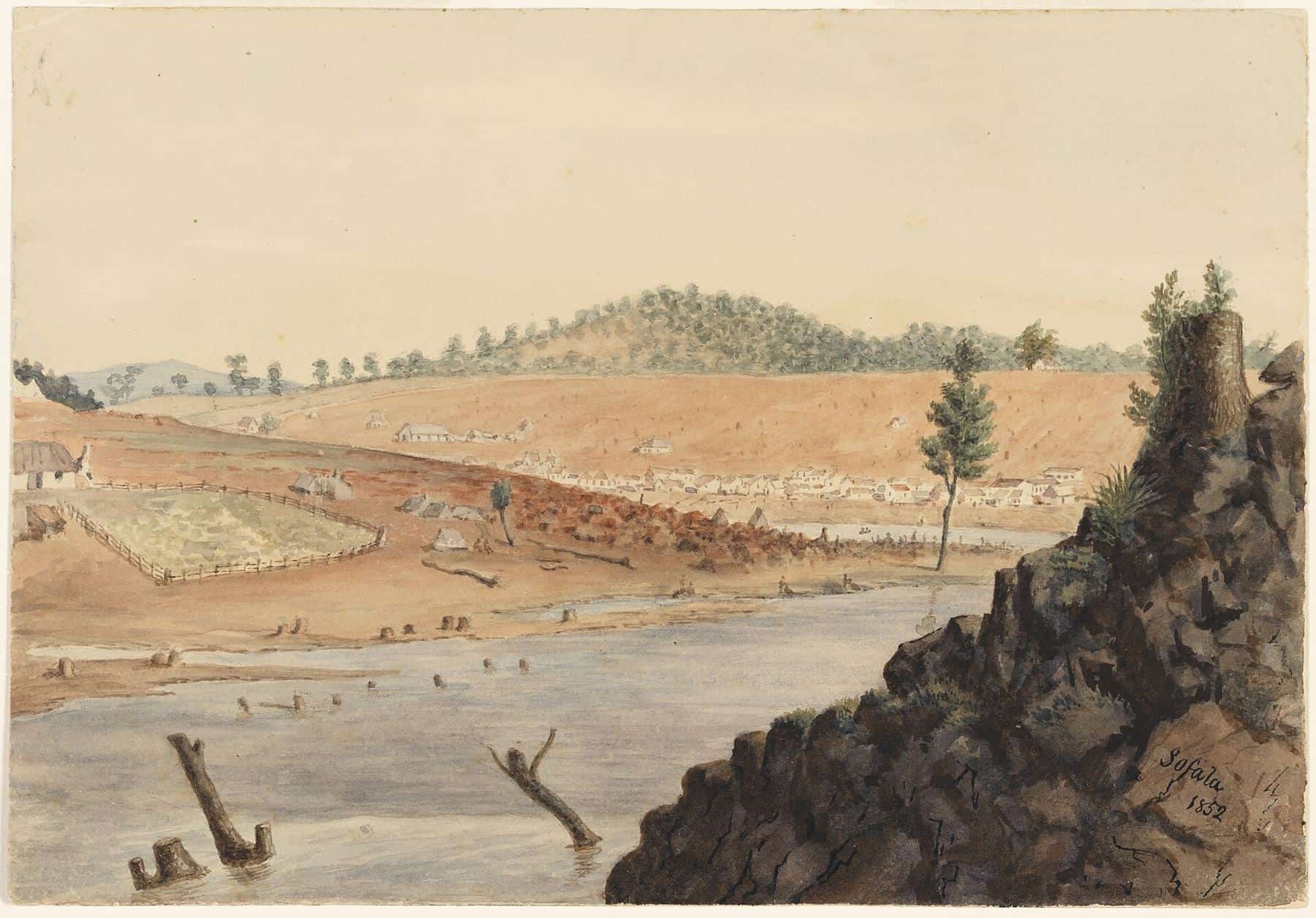
Head north on the road towards Mudgee to reach Sofala, on the Turon River, about 45 minutes from Bathurst. The Turon diggings were among the richest of the 1851–52 rushes, and Sofala has kept a strong period atmosphere — timber shopfronts with deep verandahs, a pub and a scatter of cottages climbing the hillside. Artists, including Russell Drysdale, have long been drawn to it. Gold dust can still be found in the Turon; if you want to try, read our fossicking rules first.
Detour: Hill End
From Sofala or directly from Bathurst, the road climbs to Hill End, which at its peak in the early 1870s was a town of several thousand people. When the reef gold ran out the population collapsed, and so much survived untouched that the town was declared a historic site in 1967. Today NSW National Parks manages it, and you can wander between original cottages, churches, hotels and mine sites. Hill End is where the Holtermann specimen — about 286 kg of gold, quartz and slate — was found in October 1872. Our Hill End guide covers it in detail; allow at least half a day.
Lucknow
Back on the Mitchell Highway between Bathurst and Orange, Lucknow is easy to drive straight through, but its hillsides are dotted with poppet heads, mine buildings, mullock heaps and stone dam walls. Gold was found here in 1851, soon after the Ophir discovery. The field sat on land belonging to William Charles Wentworth and was known as the Wentworth field until it took the name Lucknow in the 1860s. Several relics are visible from the road; respect private property and fences.
Orange and Ophir
Orange is today a regional food and wine centre, and a comfortable base. The poet A. B. “Banjo” Paterson was born near Orange in 1864, and the city has parks, gardens and heritage streetscapes worth a walk.
The optional detour to Ophir, about 25 kilometres north-east of the city, is the trail’s historical heart. On 12 February 1851 Hargraves, John Lister and the brothers William and James Tom washed the first specks of gold from Lewis Ponds Creek, near its junction with Summer Hill Creek. Lister and the Toms later found the payable quantities that confirmed the field while Hargraves sought a government reward — a disagreement over credit that rumbled on for decades. Hargraves named the diggings Ophir, after the biblical land of gold. The Ophir Reserve today has picnic areas, walking tracks to the old workings and a public fossicking area along the creek. Read more in The 1851 discovery and the first rush.
Cudal and Canowindra
West of Orange the land opens into the Lachlan valley. Cudal is a small farming village on the way. Canowindra, on the Belubula River, has a curving main street lined with old hotels and shops. In October 1863 Ben Hall’s gang occupied the town for several days, holding residents at a hotel in an episode remembered as much for its bravado as for its menace. Canowindra is also known for the Age of Fishes Museum, which displays fossil fish found nearby.
Eugowra and Escort Rock
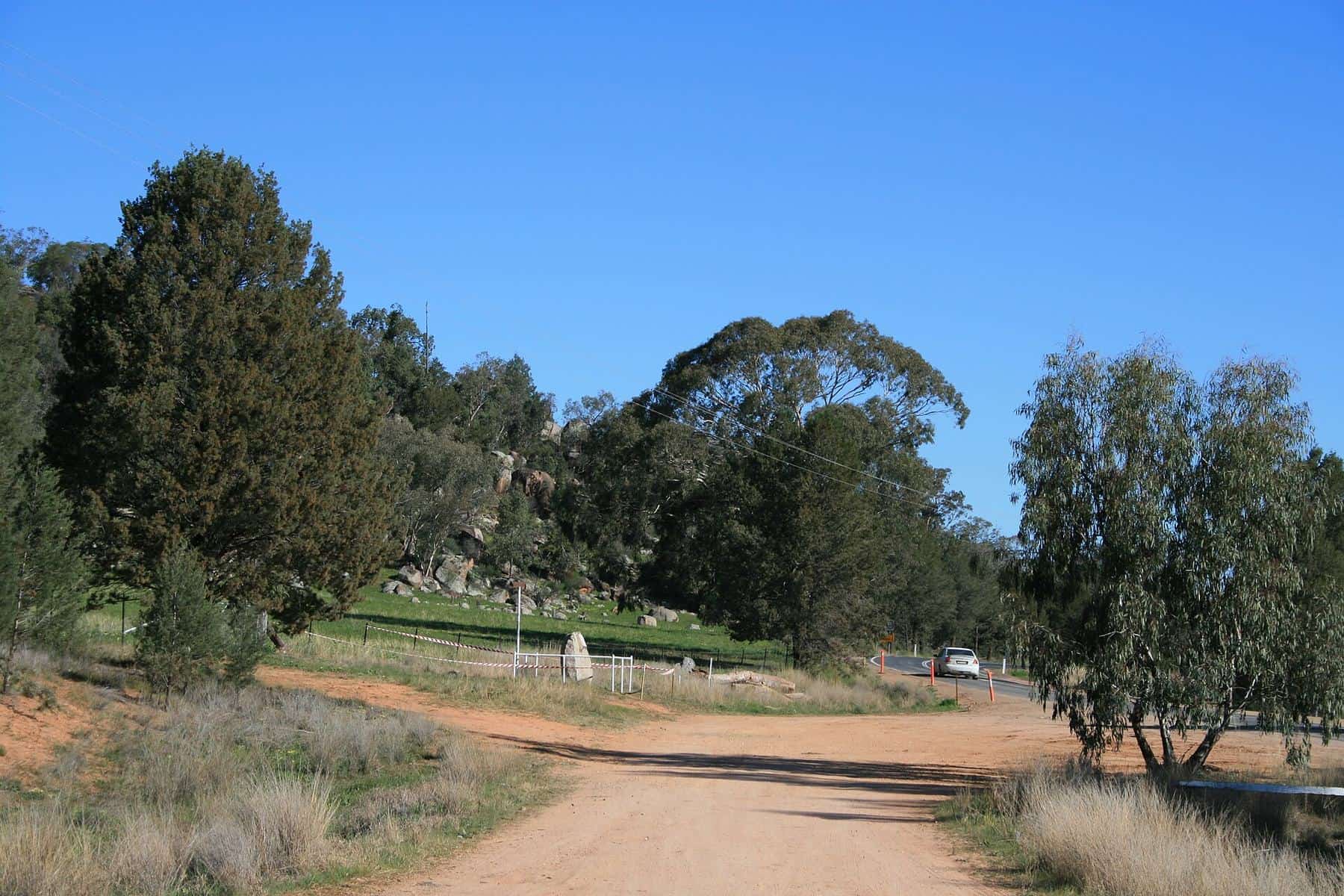
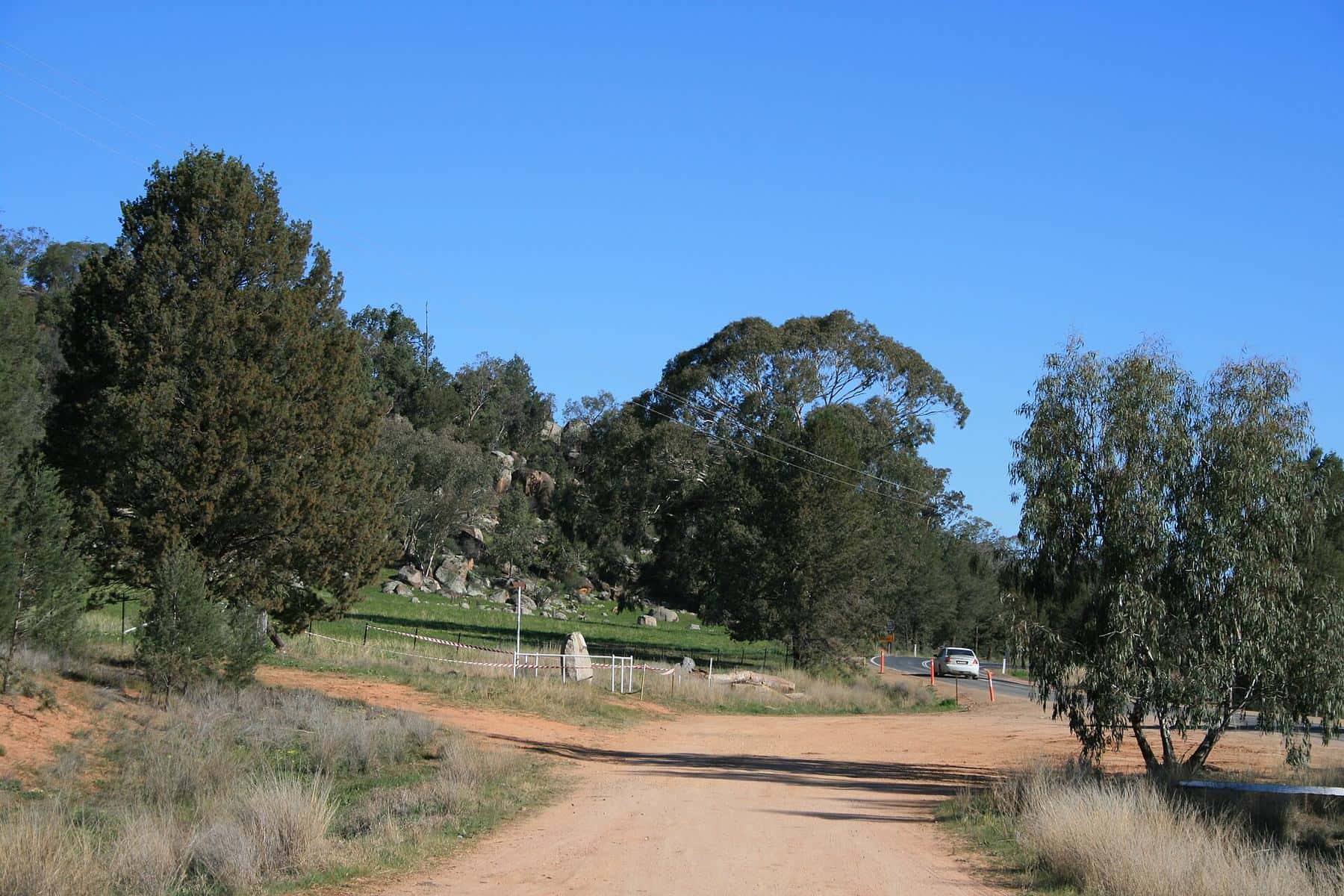
The trail’s namesake lies a few kilometres east of Eugowra. On the afternoon of Sunday 15 June 1862, the gold escort coach from Forbes, carrying a driver and four police, slowed to pass two bullock drays blocking the road beside a cluster of granite boulders. Frank Gardiner’s gang — among them Ben Hall, John Gilbert and John O’Meally — opened fire from behind the rocks. Two police were wounded, the horses bolted, the coach overturned, and the gang made off with 2,719 ounces of gold and £3,700 in cash. It is usually described as the largest gold robbery in Australian history.
A roadside area at Escort Rock has interpretive signs, and you can still see the line of the original coach road. In Eugowra itself, a series of murals on buildings tells the story of the robbery and of the town. Read the full account in our Escort Rock robbery story.
Forbes
The trail ends in Forbes, which grew rapidly after gold was found on the Lachlan in 1861. Its wide streets and grand hotels date from the gold era. Ben Hall was shot dead by police on Goobang Creek, north-west of town, on 5 May 1865, and his grave in the Forbes cemetery remains one of the most visited bushranger sites in Australia. The town’s museum has displays on the bushranging years.
Escort Rock trail checklist
0 of 8 done
Ticks are saved in this browser only.
Suggested two-day itinerary
Day 1 — Bathurst, Sofala and Hill End. Morning in Bathurst, then drive to Sofala for lunch. Continue to Hill End for the afternoon and stay overnight if you can — the town is at its most atmospheric early and late in the day. Otherwise return to Bathurst.
Day 2 — Lucknow to Forbes. Drive via Lucknow to Orange, take the Ophir detour, and continue west through Cudal and Canowindra. Stop at Escort Rock and Eugowra’s murals in the afternoon and finish in Forbes.
Where to next
From Forbes, the Ben Hall Gang Gold Trail runs south-east through Grenfell and Young to Yass, while the Newell Gold Trail heads north to Parkes and Peak Hill. See all six trails.
Frequently asked questions
How long is the Escort Rock Gold Trail?
The main route from Bathurst to Forbes is about 200 km and roughly two and a half hours of driving. Adding the Sofala and Hill End detours makes it a comfortable two-day trip.
Where exactly is Escort Rock?
Escort Rock is on the Escort Way a few kilometres east of Eugowra, between Orange and Forbes. A roadside area with interpretive signs marks the site of the June 1862 gold escort robbery.
Can you pan for gold at Ophir?
Yes. The Ophir Reserve on Summer Hill Creek north-east of Orange is a popular public fossicking spot. Hand tools only, and follow the NSW fossicking rules and any reserve signage.
Is Hill End worth the detour from Bathurst?
Yes. Hill End is the most intact gold town in NSW and is managed as a historic site by NSW National Parks. Allow at least half a day, and note the access roads are narrow and winding.
Sources and further reading
Facts on this page were checked against these primary and official sources. Conditions change — confirm before you travel or buy.
- Escort Rock (with contemporary newspaper references) — Wikipedia
- Hill End Historic Site — NSW National Parks and Wildlife Service
- Edward Hammond Hargraves — Discover Collections — State Library of NSW
- Fossicking in NSW — NSW Resources
- Frank Gardiner and the Eugowra escort robbery — Central NSW Museums