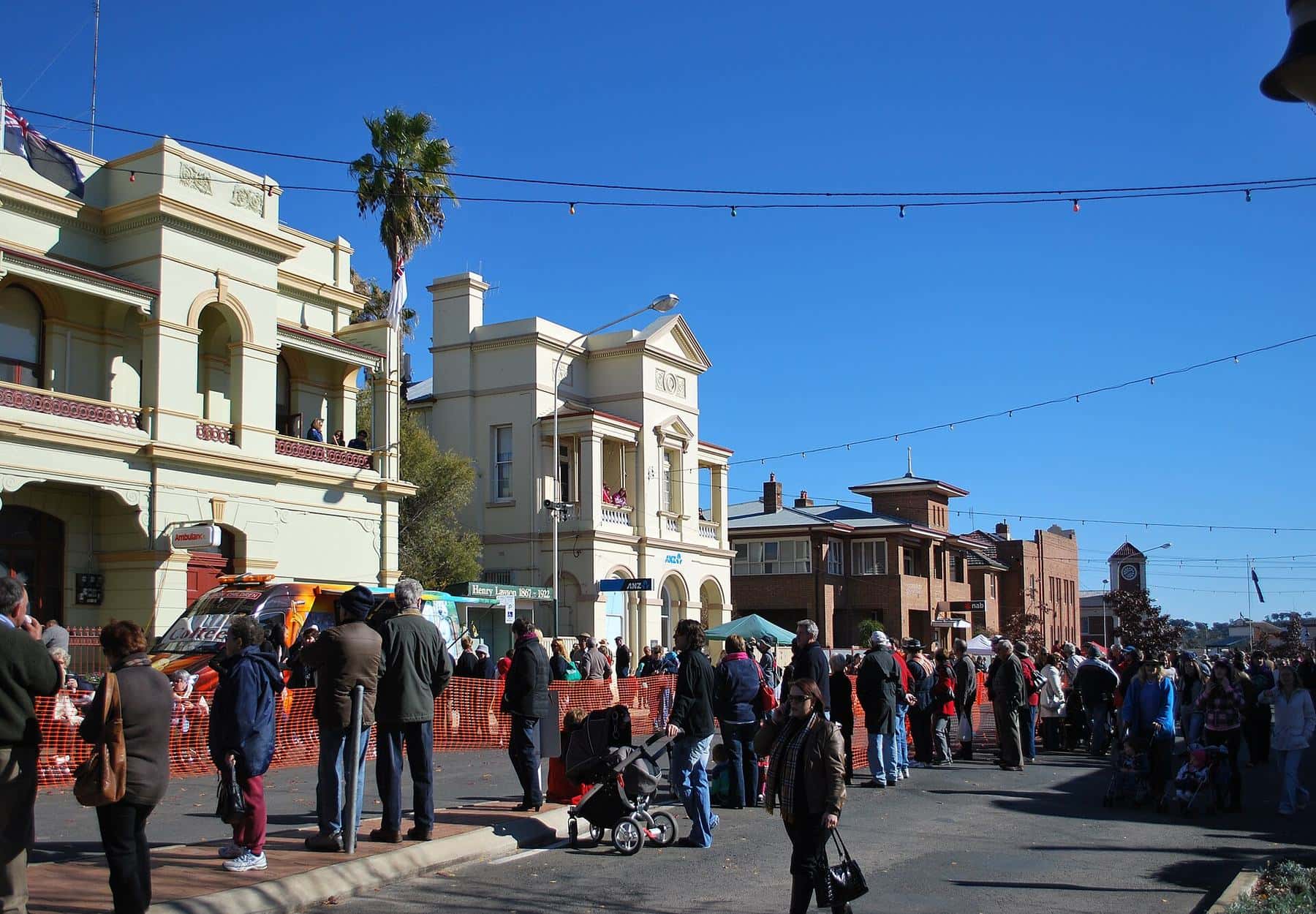
The gold rush created towns almost overnight — and abandoned many of them just as fast. Some, like Bathurst, Orange and Goulburn, were already established and grew rich on the trade. Others, like Hill End, Sofala and Kiandra, existed only because of gold. This A–Z covers the places on our six recommended trails. Towns with their own in-depth guide are linked; for the rest we give a short, checked summary and the trail you will find them on.
Start with these
- Hill End — the most complete surviving gold town in NSW, home of the Holtermann specimen. Escort Rock and Abercrombie trails (optional detour).
- Bathurst — Australia’s oldest inland European settlement, proclaimed by Governor Macquarie in 1815, and the town where Hargraves announced the gold discovery in May 1851. Escort Rock and Abercrombie trails.
- Young — formerly Lambing Flat, scene of the 1861 riots against Chinese miners. Ben Hall Gang trail. Read the Lambing Flat story.
- Forbes — centre of the Lachlan goldfield and the town where bushranger Ben Hall is buried. Ben Hall Gang, Escort Rock and Newell trails.
- Adelong — gold-mill ruins beside Adelong Falls and a National Trust-listed main street. Southern trail.
A–Z of gold trail towns
Adelong
A small town on Adelong Creek whose reef gold supported mining for decades. The Adelong Falls Gold Mill Ruins preserve the stonework of a processing mill, its water race and machinery foundations. Southern.
Abercrombie Caves
A karst reserve south of Bathurst with one of the largest natural limestone arches in the Southern Hemisphere. Gold was worked in the surrounding hills and creeks. Abercrombie.
Barmedman
A wheatbelt village with a mining history; a quiet stop between Temora and Wyalong. South-Western, Newell (optional).
Bathurst
Proclaimed in 1815, Bathurst became the supply and administrative centre for the first goldfields. Visit Chifley Home, the courthouse precinct and, for a change of pace, drive Mount Panorama when the circuit is open as a public road. Escort Rock, Abercrombie.
Binalong
A tiny village on the Ben Hall country road where bushranger John Gilbert is buried after he was shot by police in May 1865. Southern, Ben Hall Gang, South-Western.
Binda
Crookwell-district village remembered for the night in December 1864 when Ben Hall’s gang held up a Boxing Day dance. Abercrombie.
Bookham, Bowning and Burrinjuck
Small Yass Valley localities near the Hume Highway with early coaching and pastoral history; good detours for travellers based in Yass.
Canowindra
A Lachlan valley town whose main street was held for several days by Ben Hall’s gang in 1863. Also known for its fossil fish discoveries. Escort Rock.
Cootamundra
A railway town and the birthplace of Sir Donald Bradman in 1908. Ben Hall Gang and South-Western (optional).
Crookwell
A high-country town on the Great Dividing Range, with nineteenth-century buildings and goldmining and bushranger stories in the district. Abercrombie.
Cudal, Eugowra and Escort Rock
Cudal is a farming village on the Escort Way. Eugowra is famous for its murals and for Escort Rock, a few kilometres away, where the gold escort was ambushed in June 1862. Escort Rock.
Forbes
Gold was found at Forbes in 1861 and the town grew rapidly as the centre of the Lachlan goldfield. Ben Hall’s grave is in the town cemetery. Ben Hall Gang, Escort Rock, Newell.
Goulburn
Proclaimed a city by letters patent in 1863, Goulburn served the southern goldfields as a commercial and administrative centre. Abercrombie.
Grenfell
Gold was discovered at Grenfell in 1866. The writer Henry Lawson was born on the goldfield the following year. O’Brien’s Hill preserves old mine workings and machinery. Ben Hall Gang.
Gundagai
A Murrumbidgee River town devastated by the flood of 1852, when Wiradjuri men Yarri and Jacky Jacky rescued dozens of people in bark canoes. The Dog on the Tuckerbox stands beside the Hume Highway north of town. Southern, South-Western.
Harden and Murrumburrah
Twin towns with Chinese graves, a local museum and stories of the Hall and Gardiner gangs. Ben Hall Gang, South-Western.
Jugiong
A Murrumbidgee village that grew around a coaching inn. Sergeant Edmund Parry was shot dead nearby during a hold-up by Gilbert, Hall and Dunn in November 1864. Southern, Ben Hall Gang (optional).
Kiandra
A high-plains goldfield, now in Kosciuszko National Park, where a rush from late 1859 drew thousands of diggers before collapsing within about a year. Southern.
Lucknow
Just east of Orange, Lucknow’s goldfield was worked from 1851; poppet heads, mine buildings and mullock heaps remain visible. Escort Rock.
Newbridge, Trunkey Creek and Tuena
Villages on the Abercrombie back roads. Tuena keeps goldfields-era buildings; Trunkey Creek has historic hotels. Abercrombie.
Ophir
The Ophir Reserve on Summer Hill Creek, north-east of Orange, marks the site of the 1851 discovery and is a popular public fossicking area. Escort Rock (optional).
Orange
A regional city surrounded by orchards and vineyards, close to Ophir and Lucknow. The poet Banjo Paterson was born near Orange in 1864. Escort Rock.
Parkes and Peak Hill
Parkes began as a gold settlement; Peak Hill has a walking track around a former open-cut gold mine. Newell.
Sofala
On the Turon River north of Bathurst, Sofala was one of the earliest and richest goldfields of 1851–52 and still looks the part. Escort Rock and Abercrombie (optional).
Tarago
A former staging post and railhead with the historic Loaded Dog Hotel. Abercrombie (optional).
Temora, Wyalong and West Wyalong
Later reef goldfields of the 1880s and 1890s on the wheatbelt. South-Western, Newell.
Tumut
A river town in the Snowy Mountains foothills and a base for Adelong, Batlow and Kiandra. Southern.
Wallendbeen
A farming village between Harden and Cootamundra, near where Ben Hall’s gang shot storekeeper John Barnes in 1863. Ben Hall Gang, South-Western.
Yass
A key stop on the Great Southern Road and an early police centre for the bushranging years. Southern, Ben Hall Gang, South-Western (optional).
Other villages on the old Gold Trails map
The original Gold Trails project also listed many smaller localities — among them Blayney, Boorowa, Bungonia, Caragabal, Cowra, Galong, Greenethorpe, Gundaroo, Junee, Khancoban, Koorawatha, Marulan, Molong, Monteagle, Murringo, Murrumbateman, Oberon, Quandialla, Stockinbingal, Sutton, Temora, Towrang, Tumbarumba, Wallaroo and Wyangala. Most have a pub, a war memorial, a cemetery worth a wander and a story or two from the gold era. Ask at the nearest visitor centre for local heritage walks.
Guides in this section
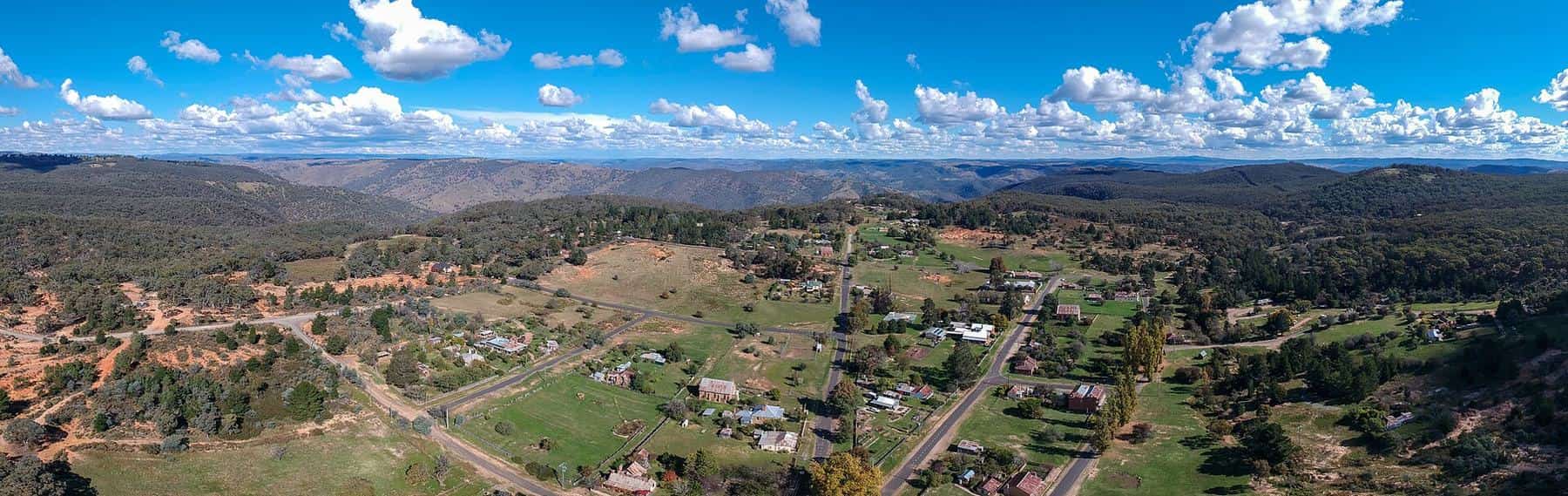
Frequently asked questions
What is the best preserved gold town in NSW?
Hill End, north-west of Bathurst, is generally regarded as the best preserved. It was declared a historic site in 1967 and is managed by NSW National Parks, with original cottages, hotels, churches and mine sites.
Which NSW gold town has the best museum?
Several are worth a stop — the Lambing Flat Folk Museum in Young, the museums at Hill End, and the Chinese and gold history displays in towns such as Harden and Grenfell. Opening days vary, so check before you go.
Is Kiandra still a town?
No. Kiandra is now an abandoned goldfield inside Kosciuszko National Park. A few structures and interpretive signs remain, and the area is reached via the Snowy Mountains Highway.
Sources and further reading
Facts on this page were checked against these primary and official sources. Conditions change — confirm before you travel or buy.
- Hill End Historic Site — NSW National Parks and Wildlife Service
- Visit NSW — Country NSW destinations — Destination NSW
- Australian Dictionary of Biography — Australian National University