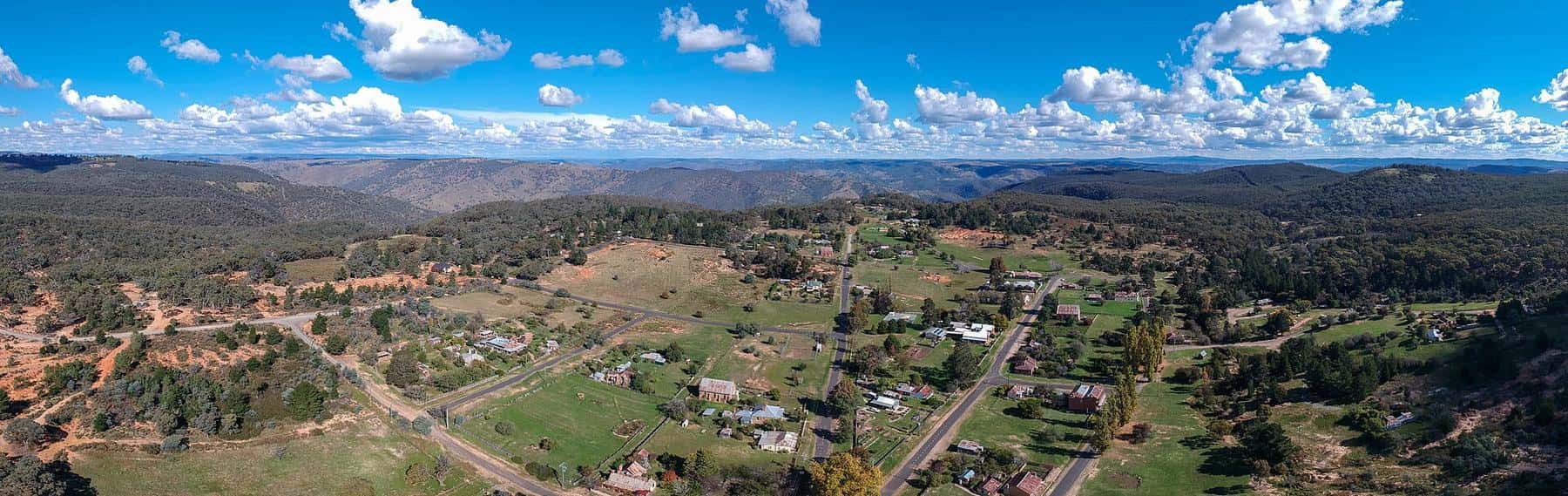
Hill End sits on a plateau above the Turon and Macquarie rivers, about 75 kilometres north-west of Bathurst. It is a place of open paddocks dotted with old cottages, exotic trees planted by long-gone residents, and the rusting remains of mines. For anyone following the Gold Trails, it is the essential stop.
~75 km
From Bathurst
About 1¼ hours
1872
Boom year
Reef gold discoveries
1967
Historic site
Managed by NPWS
From alluvial diggings to reef gold
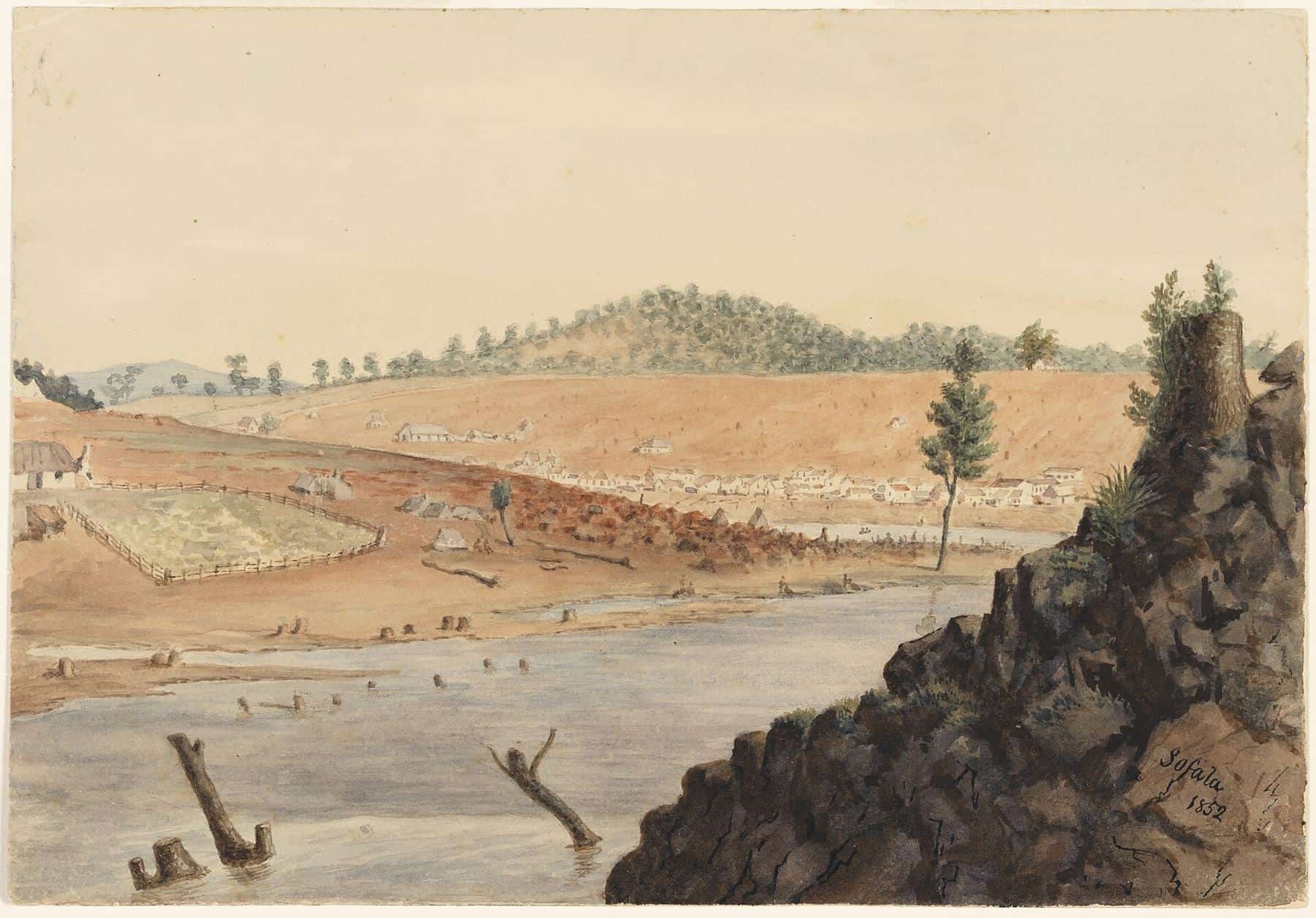
Gold was worked along the creeks around Hill End and neighbouring Tambaroora from the early 1850s, soon after the first rushes on the Turon. Alluvial miners came and went for two decades. The great boom came in the early 1870s when rich gold-bearing quartz reefs were opened on Hawkins Hill. Companies were floated, crushing batteries erected and the population soared to several thousand. Hotels, banks, churches and stores lined the streets, and for a short time Hill End was one of the busiest towns in the colony.
The Holtermann nugget
The most famous find came on 19 October 1872 at the Star of Hope mine, owned by Bernhardt Holtermann and Louis Beyers. Miners broke out a massive slab of reef gold weighing around 286 kilograms, containing an estimated 93 kilograms of gold. It remains the largest single specimen of reef gold recorded. Rather than being preserved, it was crushed and the gold extracted, but not before it was photographed with Holtermann standing beside it.
The Holtermann photographs
Holtermann used part of his fortune to fund an extraordinary photographic project. Beaufoy Merlin and his assistant Charles Bayliss of the American & Australasian Photographic Company documented Hill End and Gulgong street by street, capturing shopfronts, families, miners and the townscape on glass-plate negatives. The negatives were rediscovered in 1951 and are now held by the State Library of NSW. Many of the buildings you see today can be matched to these images, and interpretive signs around the town reproduce them.
Decline and survival
The reefs proved patchy and the boom faded within a few years. Population fell sharply, buildings were removed or left to decay, and Hill End became a quiet village. That decline preserved its character. In 1967 the town was declared a historic site, now managed by NSW National Parks and Wildlife Service. A small community still lives in Hill End, alongside the protected heritage buildings.
Things to do
- Visitor centre — start at the NPWS visitor centre in the old hospital building for maps, displays and current information on tours.
- Heritage walks — self-guided walks lead past the cottages, churches, the Royal Hotel and the sites of vanished buildings marked with Holtermann photographs.
- Mine relics — see poppet heads, mullock heaps and machinery around Hawkins Hill. Underground tours at the Bald Hill mine have been offered in the past; check with NPWS whether they are operating.
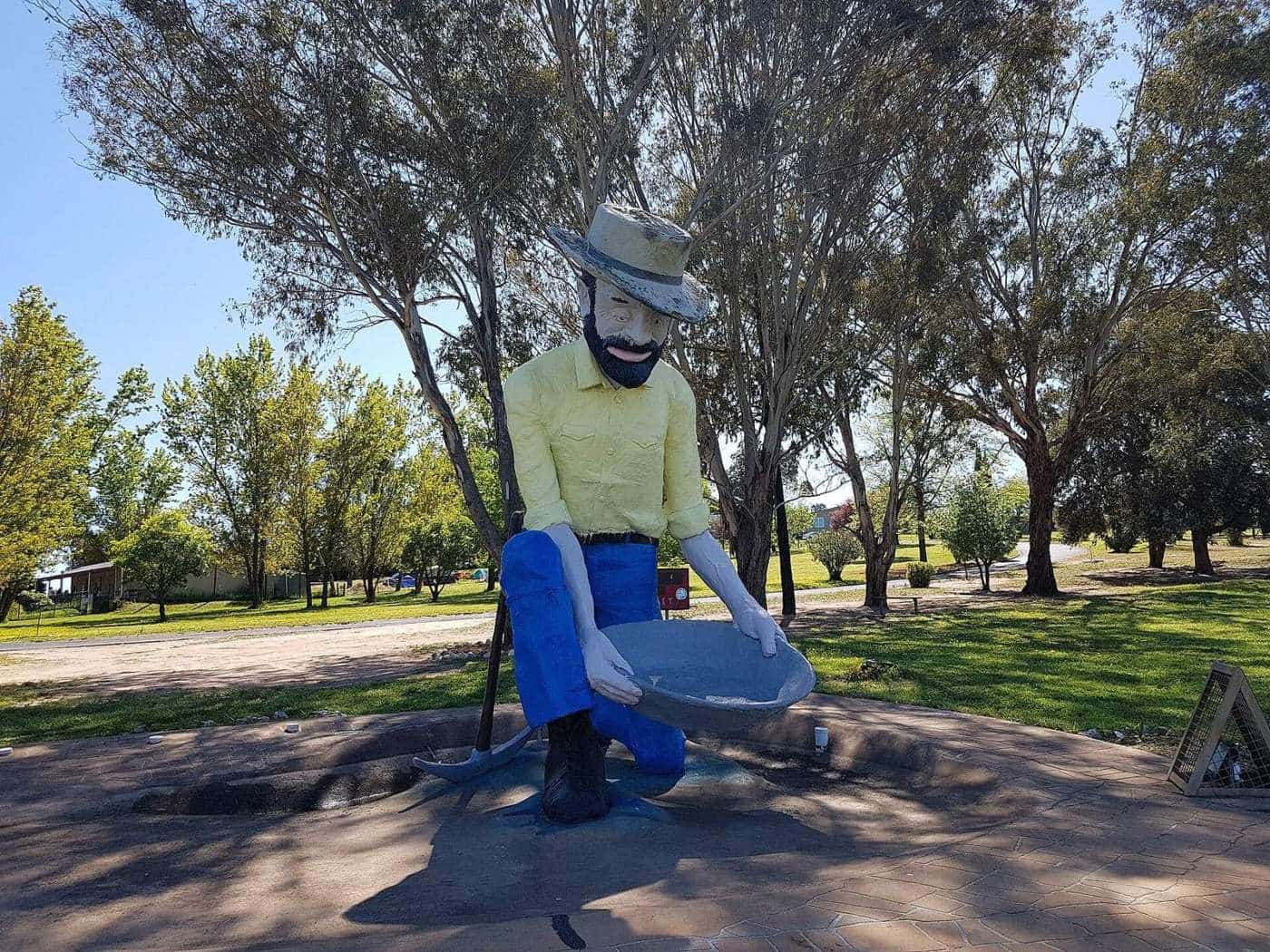
- Fossicking — try your luck in designated areas (see our fossicking guide).
- Art — Hill End has attracted artists since the 1940s, including Russell Drysdale, Donald Friend and Brett Whiteley. Bathurst Regional Art Gallery runs an artists-in-residence program in the village.
- Tambaroora — explore the scattered remains and cemetery of Hill End’s twin settlement just to the north.
Hill End checklist
0 of 7 done
Ticks are saved in this browser only.
What happened to Holtermann?
Bernhardt Holtermann had arrived from Germany in 1858 and worked for years without much luck before the Star of Hope paid off. With his wealth he moved to Sydney and built a grand house with a tower at St Leonards, on the north shore, where he planned photographic work. The house still stands as part of the Sydney Church of England Grammar School (Shore). He entered politics, serving in the NSW Legislative Assembly, and promoted the colony overseas using the photographs he had commissioned. He died in 1885. His story, from penniless digger to patron of photography, is one of the reasons Hill End’s past is so well recorded.
A suggested day at Hill End
- Morning: collect a map at the visitor centre, then walk the main street, using the Holtermann images on the signs to picture the 1872 town.
- Midday: lunch at the pub or a picnic under the old exotic trees, then drive or walk up to the Hawkins Hill lookout and mine relics.
- Afternoon: try your luck at a designated fossicking spot, or explore Tambaroora and its cemetery.
- Evening: stay over. With little light pollution, the night sky over the plateau is spectacular.
Getting there
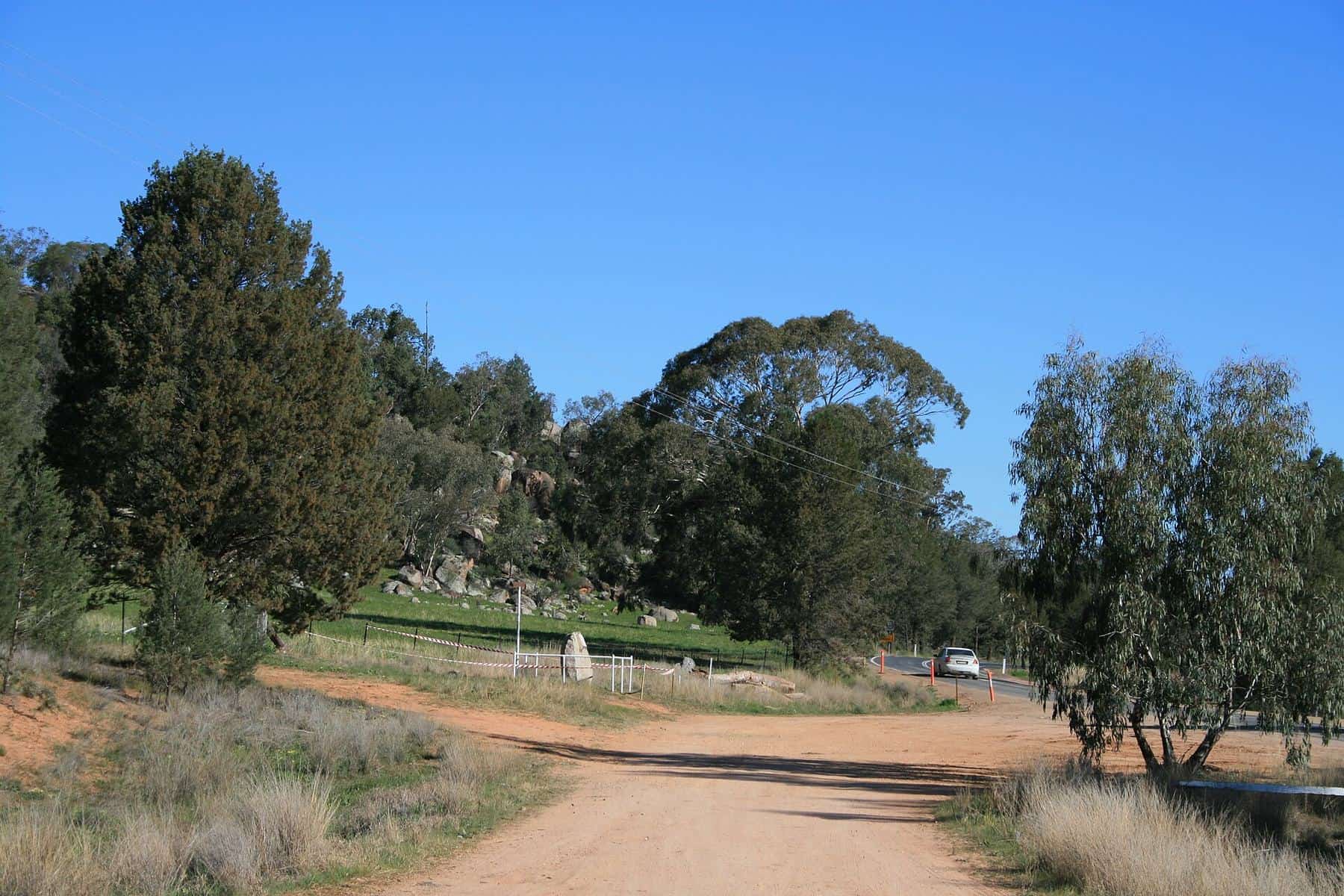
From Bathurst, the sealed route runs via Eglinton and Turondale. The road via Sofala includes steep, unsealed sections — fine in dry weather for confident drivers, but not recommended for caravans or after rain. Allow time: the drive is part of the experience.
Where to stay
NPWS operates campgrounds at Hill End with sites for tents and caravans, and there is a limited range of cottages, guesthouses and pub rooms. Book ahead on weekends and school holidays. Fuel and supplies are limited, so fill up in Bathurst or Mudgee.
Hill End is the centrepiece of our Escort Rock Gold Trail and pairs naturally with Sofala and Bathurst. For the wider history, read how gold was discovered in NSW.
Frequently asked questions
How far is Hill End from Bathurst?
Hill End is about 75 kilometres north-west of Bathurst, roughly a 1¼-hour drive. Part of the route is winding, and the alternative road via Sofala includes steep unsealed sections not suited to caravans.
What is the Holtermann nugget?
A huge specimen of gold and quartz found in the Star of Hope mine at Hill End on 19 October 1872. It weighed about 286 kg and contained an estimated 93 kg of gold. It was crushed for its gold rather than kept.
Can you fossick at Hill End?
Yes, in designated areas. Ask at the NPWS visitor centre for current locations and rules; fossicking is by hand methods only.
Is Hill End a ghost town?
Not quite. A small community still lives there, and NSW National Parks and Wildlife Service manages the Hill End Historic Site, declared in 1967.
Sources and further reading
Facts on this page were checked against these primary and official sources. Conditions change — confirm before you travel or buy.
- Hill End Historic Site — NSW National Parks and Wildlife Service
- Holtermann, Bernhardt Otto (1838–1885) — Australian Dictionary of Biography
- The Holtermann Collection — State Library of New South Wales
- Hill End and Tambaroora Gathering Group — Community heritage group