The timeline below gathers the turning points of the NSW gold story. Use the buttons to filter by theme. Dates are drawn from the State Library of NSW, the Australian Dictionary of Biography, the Australian Museum and contemporary newspapers; where sources disagree we say so in the linked guides.
1815 · Bathurst
Governor Macquarie proclaims Bathurst, the first European town west of the Blue Mountains. It later becomes the supply centre for the first goldfields.
12 Feb 1851 · Lewis Ponds Creek
Edward Hargraves, with John Lister and William and James Tom, washes the first specks of gold near the junction with Summer Hill Creek.
15 May 1851 · Bathurst
Hargraves announces the discovery publicly. The diggings, named Ophir, are rushed within days.
May 1851 · Sydney
The government asserts Crown ownership of gold and introduces a digging licence of 30 shillings a month, administered by gold commissioners.
1851 · Turon River
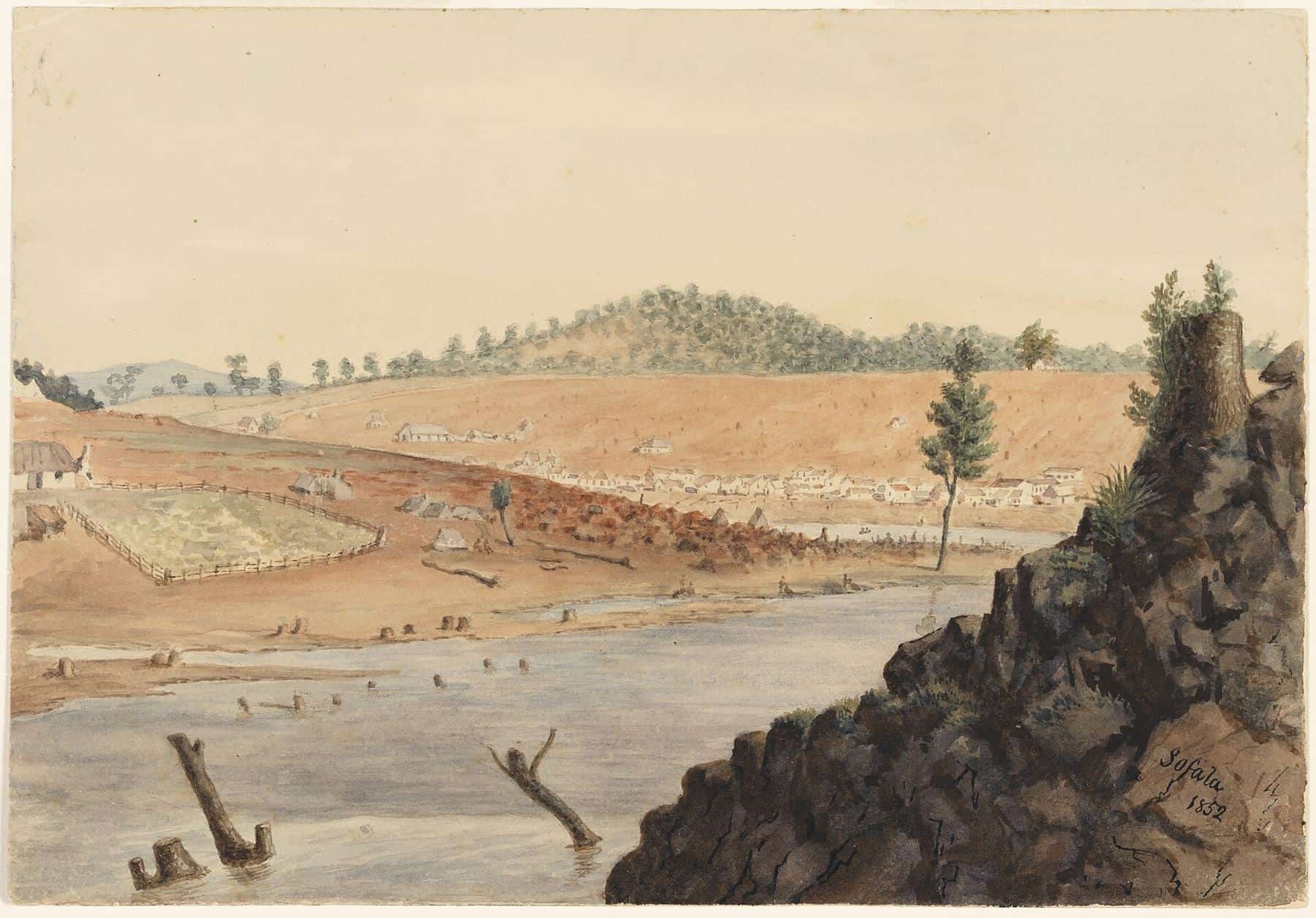
Rich alluvial gold is found on the Turon; Sofala becomes one of the busiest early fields.
1852 · Gundagai
A great flood on the Murrumbidgee destroys the old town on the river flats. Wiradjuri men Yarri and Jacky Jacky rescue dozens of people by canoe.
1859–60 · Kiandra
Gold on the high plains sparks a rush of thousands of diggers into alpine country. The field declines within about a year.
30 Jun 1861 · Lambing Flat
Thousands of European miners drive Chinese diggers from the Burrangong field in the worst of a series of riots.
14 Jul 1861 · Lambing Flat
About 1,000 miners attack the police lock-up to free arrested ringleaders; one miner is killed. Martial law follows on 17 July.
22 Nov 1861 · Sydney
An Act to regulate and restrict Chinese immigration is assented to, imposing a £10 entry fee on new arrivals.
1861 · Forbes
Gold is found on the Lachlan and Forbes grows rapidly into the centre of a major goldfield.
15 Jun 1862 · Escort Rock
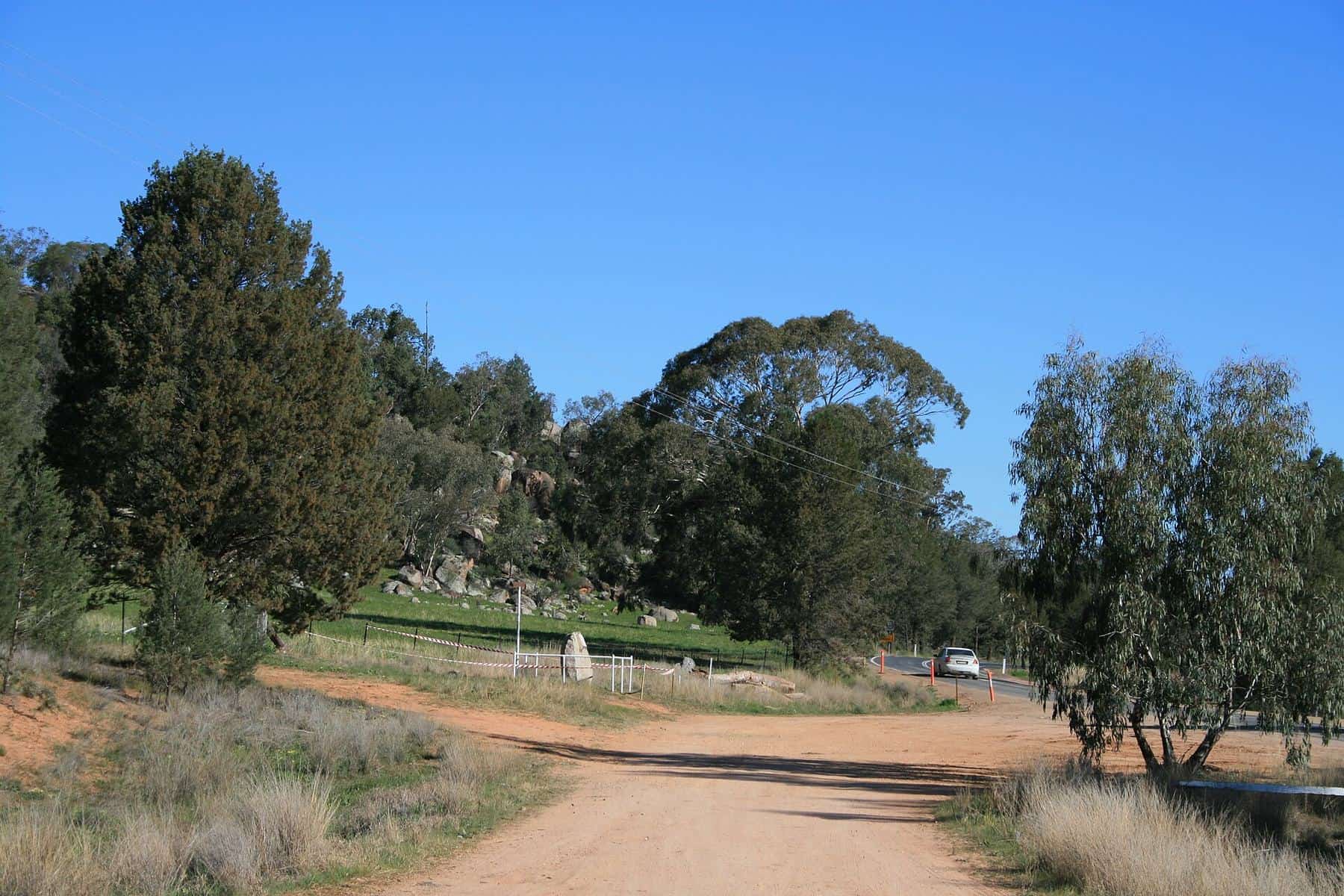
Frank Gardiner’s gang ambushes the Forbes gold escort near Eugowra, taking 2,719 ounces of gold and £3,700 in cash.
Oct 1863 · Canowindra
Ben Hall’s gang occupies Canowindra for several days, holding townspeople at the hotel.
16 Nov 1864 · Jugiong
Sergeant Edmund Parry is shot dead during a coach hold-up by Gilbert, Hall and Dunn.
26 Dec 1864 · Binda
Hall, Gilbert and Dunn hold up the village and a Boxing Day dance.
5 May 1865 · Forbes
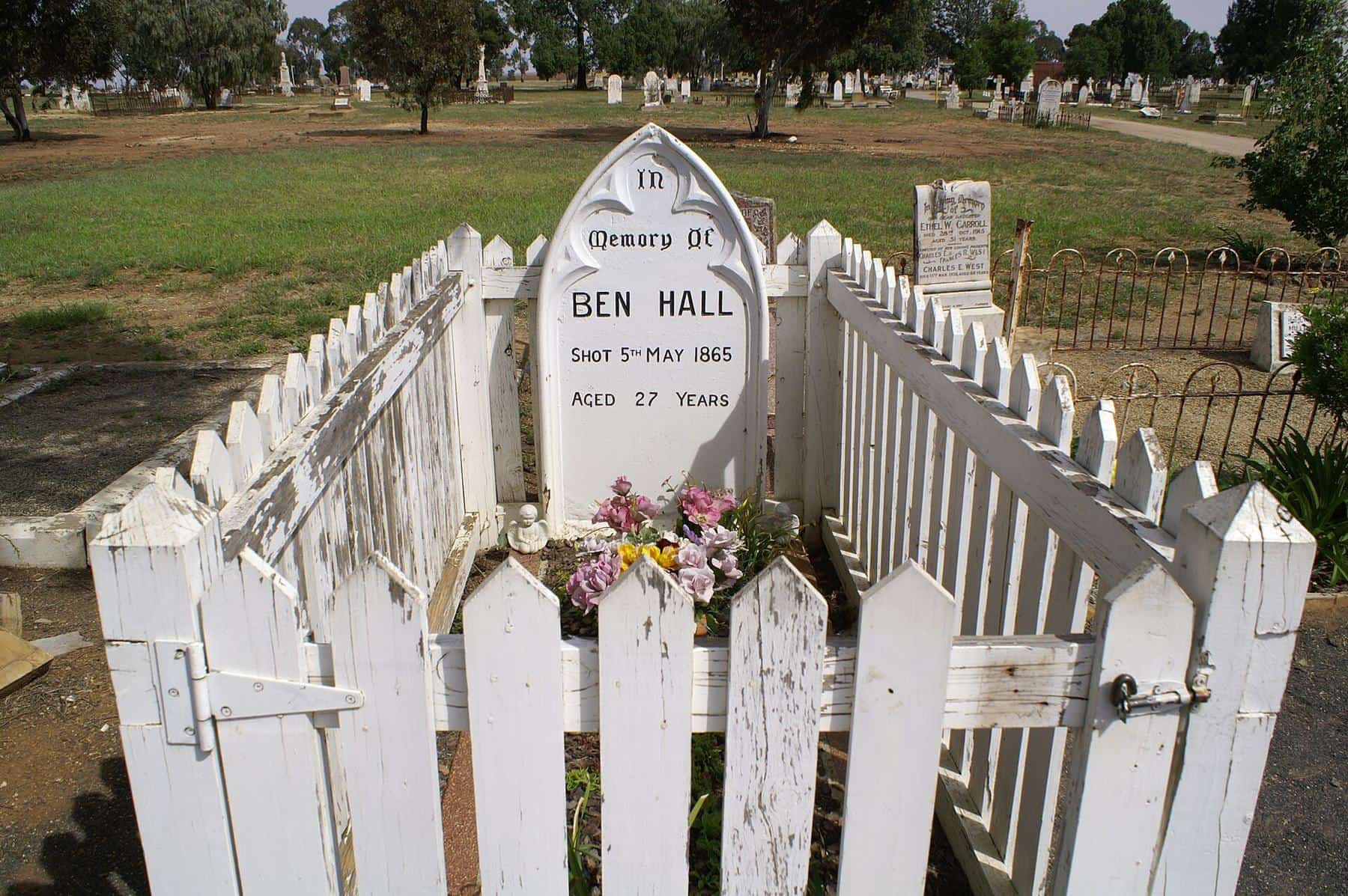
Ben Hall is shot dead by police on Goobang Creek, north-west of Forbes, and buried in Forbes cemetery.
13 May 1865 · Binalong
John Gilbert is shot dead by police near Binalong, where he is buried.
1866 · Grenfell
Gold is discovered at what becomes Grenfell. Henry Lawson is born on the goldfield on 17 June 1867.
19 Oct 1872 · Hill End
The Holtermann specimen — about 286 kg of gold, quartz and slate — is uncovered in the Star of Hope mine on Hawkins Hill.
1880s–90s · Temora & Wyalong
New reef goldfields open in the wheatbelt, giving rise to Temora, Wyalong and West Wyalong.
1967 · Hill End
Hill End is declared a historic site, now managed by NSW National Parks.
How to read the timeline
The rush unfolded in waves. The 1851–53 wave was driven by alluvial gold — gold washed into creek beds that individuals could recover with a pan, cradle and shovel. Ophir, the Turon and the nearby creeks were worked by thousands of small parties, and many diggers moved on to Victoria after even richer finds there later in 1851.
The late 1850s and early 1860s brought rushes further afield: Kiandra in the mountains, Lambing Flat on the South West Slopes and the Lachlan fields around Forbes. These were the years of tension between European and Chinese miners and of the bushranging boom that followed the gold coaches.
From the late 1860s the emphasis shifted to quartz reefs, which needed capital, machinery and deep shafts. Hill End’s boom of 1871–74, culminating in the Holtermann find, belongs to this era, as do the later wheatbelt fields.
The wider context: Victoria, the Mint and the miner’s right
The NSW rush did not happen in isolation. Within months of the Ophir announcement, even richer fields were found in Victoria, at places such as Clunes, Ballarat and Bendigo. Many NSW diggers headed south, and by the mid-1850s Victoria was producing far more gold than New South Wales. Discontent over licence fees and policing there culminated in the Eureka Stockade at Ballarat in December 1854, a confrontation that shaped mining law across the colonies.
In NSW, gold also changed the colony’s institutions. A branch of the Royal Mint opened in Sydney in 1855 so colonial gold could be coined locally into sovereigns and half-sovereigns. The Mint building on Macquarie Street survives and is today managed by Museums of History NSW. Over the following years the much-resented monthly licence was replaced by the cheaper miner’s right, which gave holders the right to mine and, in time, a political voice.
These changes help explain why the goldfields you visit today look the way they do: the early, crowded alluvial diggings were short-lived, while the later company mines left the poppet heads, batteries and solid brick towns that survive.
Where to research further
If you want to dig into primary sources, the National Library’s Trove service lets you search digitised colonial newspapers, which reported every rush, robbery and riot. The State Library of NSW holds the Holtermann glass-plate negatives and many goldfields sketches, and the Australian Dictionary of Biography has reliable short lives of figures such as Hargraves, Ben Hall and Holtermann. Local historical societies and museums in Bathurst, Young, Forbes and Gundagai also hold collections that bring individual stories to life.
Visiting the places on the timeline
Nearly every entry above corresponds to a place on one of our routes. The Escort Rock Gold Trail passes Ophir, Sofala, Hill End and Escort Rock. The Ben Hall Gang Gold Trail links Young, Grenfell and Forbes. The Southern Gold Trail runs through Jugiong, Gundagai and on to Kiandra. Use the interactive map to plan.
Frequently asked questions
What year did the gold rush start in NSW?
1851. Gold was found at Lewis Ponds Creek near Orange on 12 February 1851 and the discovery was announced in Bathurst on 15 May 1851, starting the rush.
When did the NSW gold rush end?
There was no single end date. The great alluvial rushes faded through the 1860s, but reef mining continued for decades, with new goldfields such as Temora and Wyalong opening in the 1880s and 1890s.
Sources and further reading
Facts on this page were checked against these primary and official sources. Conditions change — confirm before you travel or buy.
- The Mint — Museums of History NSW
- Eureka Stockade — National Museum of Australia
- Edward Hammond Hargraves — Discover Collections — State Library of NSW
- Escort Rock — Wikipedia (with contemporary newspaper references)
- Hall, Benjamin (Ben) (1837–1865) — Australian Dictionary of Biography
- Glitter restored — the Holtermann “nugget” — Australian Museum
- Hill End & Tambaroora — a brief history — Hill End & Tambaroora Gathering Group